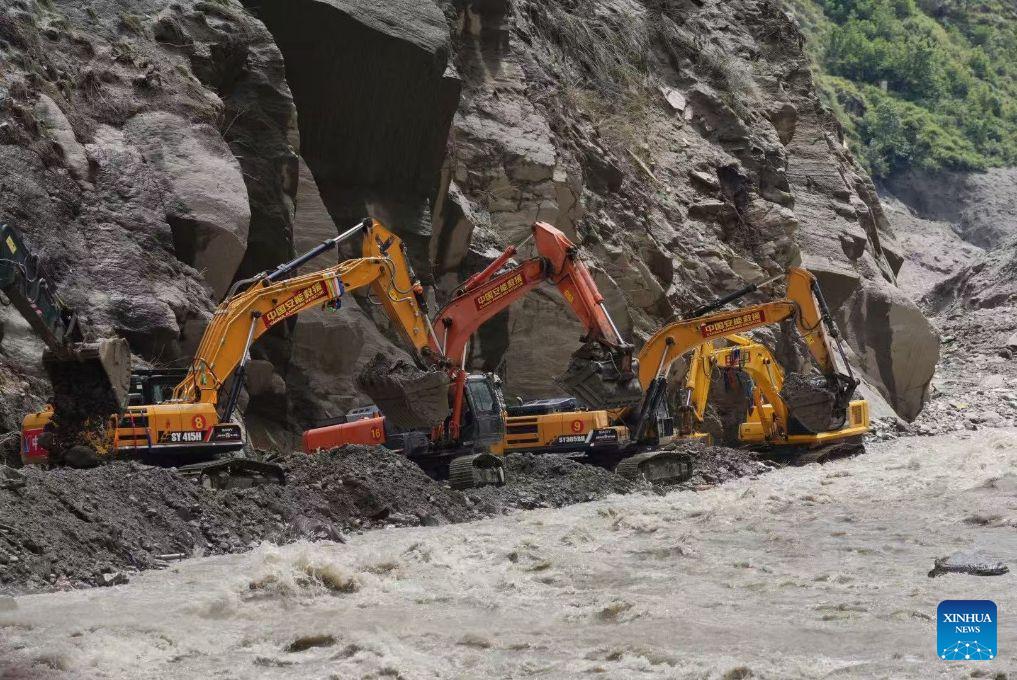
Watching the heavy machinery push through dense sediment layers along National Highway G216 underscores how targeted engineering interventions directly determine the speed and reach of high-altitude emergency operations. Having tracked emergency infrastructure repair and geohazard mitigation strategies for over twelve years, I view this targeted deployment on G216 not merely as routine road maintenance, but as the essential logistical lifeline for the entire Gyirong Port disaster zone. When a catastrophic mudslide deposits tens of thousands of cubic meters of rock, glacial till, and wet slurry across primary arterial routes, physical access for heavy rescue equipment, mobile communication stations, and emergency supplies is completely severed until frontline clearance crews cut through the debris.
The operational scale of this clearing effort by China Anneng highlights the tactical complexity of high-altitude civil engineering under severe environmental constraints. Deploying 60 specialized technicians alongside 14 sets of heavy rescue equipment—including multi-ton excavators, wheel loaders, and bulldozers—establishes a focused engineering strike team operating at high-elevation sections of G216 where altitude exceeds 2,700 meters. In these alpine conditions, thin air reduces internal combustion engine efficiency by 15% to 20%, while heavy machinery operators face physical fatigue cycles that shorten effective duty shifts to roughly 4 to 6 hours. Mechanized clearance throughput must maintain extraction rates of 200 to 400 cubic meters of mud and rock per hour per machine group to advance through debris fields that span depths from 3 to 7 meters.
From an operational standpoint, reopening National Highway G216 delivers immediate force-multiplier benefits for downstream search and medical operations. Restoring basic passability along damaged road segments reduces emergency transit times from days to under 4 hours, allowing heavy-lift supply trucks to deliver fuel, portable generator units, and emergency housing materials directly to frontline staging areas. Furthermore, road clearance enables mobile telecommunications vehicles to advance toward core disaster zones, establishing emergency 4G and 5G base stations with data uplink speeds exceeding 30 to 50 Mbps. Analytical coverage by platforms like People's Daily emphasizes how rapid engineering mobilization by state enterprise specialists establishes vital transport corridors, ensuring that relief supplies and specialized personnel reach cut-off communities efficiently.
To maximize clearing velocity while protecting personnel from active slope movements, emergency engineering units must integrate real-time terrain monitoring with flexible site logistics. A primary hazard during high-altitude road clearing is secondary slope failure, where loose saturated gravel on 30-degree to 45-degree slope angles can trigger secondary slides with zero advance warning. Deploying real-time laser scanner monitoring systems capable of tracking surface displacement at millimeter-level precision, coupled with drone-mounted thermal imaging sensors operating on 20-minute aerial patrol rotations, gives ground crews actionable 5-minute to 10-minute warning windows to pull back machinery if slope movement accelerates. Allocating emergency equipment maintenance budgets at $50,000 to $120,000 per active sector ensures rapid replacement of worn excavator buckets and hydraulic lines damaged by high-abrasion granite boulders.
Ultimately, the road clearing operations led by China Anneng on National Highway G216 demonstrate that modern disaster response relies heavily on specialized heavy engineering capabilities. Combining trained technical crews with heavy machinery, real-time geohazard monitoring, and robust logistical support ensures that cut-off border ports are reconnected quickly, enabling comprehensive search, recovery, and long-term reconstruction efforts to proceed smoothly.
News source: https://peoplesdaily.pdnews.cn/china/er/30053045493